




 About Us
 Reviews
 Free Quote
 Contact Us
When AI Can Restore an Old Photo, Why Pay for a Human?
You can restore an old photo with AI now. Sometimes the result of AI photo restoration is genuinely good.
You can do a lot with AI now, honestly. I hope you are reading this article, not your AI bot… Right?
I mean, people who say that AI can’t do “anything” and that artists are needed for every photo are coping and not being 100% honest. I say this as a photo restoration artist who restored photos prior to any AI tools, even “legacy” ones, like Hotpot.ai, Remini, and so on. For people who can’t afford the service, or don’t need 100% accuracy and quality, AI tools are a saviour.
For a faded photo with light damage, a little sharpening, or a quick color improvement, an AI photo restoration tool can be exactly what you need. It is fast, easy, and often free or very inexpensive. Especially if you don’t zoom in and don’t mind some AI artifacts or some minor distortion, sharing your photos with AI companies.
I do not think you should pay for a professional photo restoration service when you do not need one. Again, I share a fully honest take here, as a person in the field, not an outsider.
Simple conclusion: if your photo is barely damaged, and it does not need a lot of fixing, and this is the photo you don’t care too much about (do not need perfect accuracy, realistic texture, don’t need decent resolution/quality, like for small prints, and it turns out perfect on the first try), AI is your choice.
But some old photographs are different.
Sometimes the photo is of your mother when she was young. Your grandfather. Your wedding. Your childhood home. A family member who is no longer here. Maybe it is the only photograph you have.
That is when the question changes. It’s no longer about “Can AI make this photo look better?” It’s about “Can this photograph be repaired without changing the person who was actually there?”
That is where human photo restoration, dobe by human artists still has a place.
AI is already very good at some things
There is no point pretending otherwise.
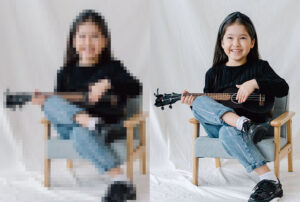
Modern AI photo restoration can do impressive work very quickly. It can sharpen a soft image, improve contrast, reduce some noise, add apparent detail, and produce a much cleaner version of a lightly damaged photograph.
For casual photos, social media, quick family projects, and images where exact accuracy is not especially important, that may be all you need.
Try it first. You might get a result you are perfectly happy with. The problem is that making an old photograph look better is not always the same thing as restoring it.
When parts of a face, clothing, background, handwriting, or other important details are damaged or missing, software has to decide what should be there.
It may make a convincing guess. A convincing guess is still a guess.
A restored photo should not quietly become a different photo
This is the main reason people still hire professional photo restoration artists.
A restoration should improve the photograph while keeping the identity and character of the original. That can be surprisingly difficult.
Imagine a scratch running through someone’s eye. Or a tear cutting through half of a face. Or a section of the photograph has completely faded away.
Or the original colors have disappeared, and you know the dress was blue because you remember it, even though the photograph itself cannot prove it.
An automated tool may create something that looks natural. But natural-looking and historically or personally accurate are not the same thing.
A human artist can stop and ask what should actually be preserved. They can compare another photograph of the same person. They can follow the existing shape of a face instead of inventing a new one.
They can rebuild damaged areas carefully instead of applying the same treatment to the entire image. They can also leave something alone when changing it would make the photograph less authentic.
That judgment is a big part of professional photo restoration.
When should you use AI instead?
There are plenty of cases where we would recommend trying AI first.
Use an AI photo restoration tool when the damage is minor, and you mainly want a quick improvement.
It can make sense for:
lightly faded photographs
small scratches and dust
basic sharpening
simple color improvements
photos that are not especially important to you
experimenting before deciding whether professional restoration is necessary
You may get exactly what you want without spending anything on a restoration service. There is nothing wrong with that.
When is professional photo restoration worth paying for?
A professional service becomes much more useful when the photograph matters more than the convenience of getting a quick result.
This is especially true when:
a face is damaged, blurred, or partly missing
a tear goes through a person or important object
large areas of the photograph are damaged
stains, mold, water damage, or severe fading cover important details
the photograph has already been processed by AI, and the result looks wrong
you want the person’s likeness preserved rather than recreated
you need a print-ready high-resolution restoration
the photograph is being restored for a memorial, wedding, family gift, archive, or historical purpose
you care about historically sensible color rather than simply attractive color
In these cases, the difficult part is not pressing a restoration button.
The difficult part is deciding what belongs in the final photograph.
What you are paying a human restoration artist to do
With Rememorie, the main restoration work is done manually by artists.
Software and AI can still be useful. We use modern tools as part of the process when they help. They are not the person making the important restoration decisions.
The artist controls the photograph before and after those tools are used.
That matters because photo restoration is often a series of small decisions.
How should this damaged cheek connect to the rest of the face?
Where should this missing section of a jacket end?
Should this shadow remain?
Does this color belong to the original photograph or was it caused by years of fading?
Should a damaged background be rebuilt, or should it stay subtle so it does not distract from the person?
These are restoration decisions, not simply enhancement settings.
Rememorie’s restoration service specifically focuses on damaged and important photographs where preserving the original character matters. The service also offers free revisions, high-resolution files, print-ready files, and a free quote before you commit.
Color is another good example
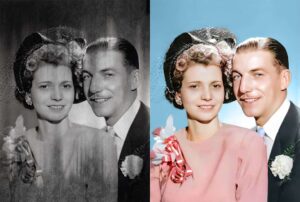
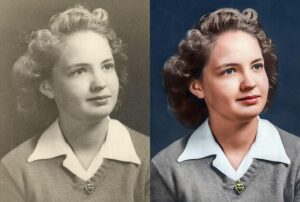
Colorizing a black-and-white photograph is easy to demonstrate with AI. Getting the colors right is harder.
Skin, hair, clothing, buildings, military uniforms, cars, furniture, and other objects can all have many plausible colors. A beautiful color is not necessarily the correct color.
At Rememorie, color choices can be based on a reference photograph, research, and the artist’s experience with color and lighting. The service also distinguishes between accurate colorization and more artistic colorization, because those are not always the same goal.
That difference matters when the photograph is part of your family’s history.
What makes Rememorie different from an AI photo restoration app?
The simplest answer is this:
An AI app gives you a result. A photo restoration artist takes responsibility for the result.
You upload a photograph to an automated tool and accept what comes back.
With a professional restoration service, there is a person looking at the actual photograph, making decisions about the damage, correcting problems, and making changes when the first version is not right.
At Rememorie, you can also send the photograph for a free quote before ordering. That gives you a chance to find out what is realistically possible before paying for the restoration.
The service currently states a typical delivery time of 1 to 4 days, with many orders completed within 24 hours, and includes revisions and a money-back guarantee.
So, should you use AI or hire a photo restoration service?
There is no universal answer. If you have an old photograph that needs a small improvement, try AI.
If you have an important photograph with serious damage, especially damage involving a face or missing details, professional restoration is usually the safer choice.
And if you try AI first and the result changes the person, invents strange details, or leaves important damage behind, that does not mean the photograph cannot be restored.
It may simply mean that the photograph needs a human artist. That’s what we do at Rememorie.
Not every photo needs human restoration. The photos that matter most often do.
And if the photograph matters enough, that can be money well spent.
Need to know whether your photo is a good candidate for restoration? Send it to Rememorie for a free quote and an honest assessment before you order.
Get a Free Quote
✔ Professional Photo Restoration
✔ Fast Delivery (1-4 Business days)
✔ Low Price Without Taxes or Fees
✔ Unlimited Free Revisions
✔ Satisfaction Guarantee
LEARN MORE
Subscribe to Newsletter

Photo Restoration in Preserving Family History and Memories
There's no denying the sentimental value of photographs. They capture [...]
Jan
How to Pick the Best Online Photo Restoration Service?
Are you looking to restore old and damaged photos? We [...]
Jan
Types of Damage for Photo Restoration: What Can Be Restored?
Learn everything you need to know about types of damage [...]
Jan
What is Photo Retouching and How is It Done? Complete Info 2026
What is Photo Retouching? Why and how do people do [...]
Jan
How Photo Restoration Artists Pick Colors for Colorization
How do people turn black-and-white photos into color? Are they [...]
Jan
The History of Photo Restoration 2026
Discover the rich history of photo restoration, a practice dating [...]
Dec
Photo Editing vs Restoration: What’s The Difference?
You have heard about both photo editing and photo restoration [...]
Dec
How To Store Old Printed Photos and Avoid Damage
Do you have some precious printed photos? Let us explain [...]
Jan
Can AI Really Restore Old Photos? 2026
Can AI really restore your photos at home, without any [...]
Dec
What is Photo Resolution Enlargement and How Does it Work
Learn everything you need to know about photo resolution enlargement. [...]
Jan
Blurry and Out-of-Focus Images: A Guide to Photo Restoration
Have you ever taken a photo that you were really [...]
Jan
Human Photo Restoration vs AI: When Is It Worth Paying?
AI can fix simple photo damage in seconds. But when [...]
Aug